- the webpage of Danica Kosanović -
- last modified -

Danica Kosanović

Pronounce c as zz in pizza, and ć as ci in ciabatta. Typeset the letter ć as \'c in LaTeX.
On some devices you are offered ć as an option after long pressing c.

Institut de Mathématiques de Jussieu - Paris Rive Gauche
(IMJ-PRG) Université Paris Cité, Sorbonne Université
Bâtiment Sophie Germain, Bureau 728
8 Place Aurélie Nemours
75013 Paris, France
danica.kosanovic[at]cnrs.fr

arXiv icon arxiv.org/a/kosanovic_d_1.html
arXiv icon zbmath.org/authors/kosanovic.danica
ORCID iD icon orcid.org/0000-0003-3923-4587

Research interests: spaces of embeddings and diffeomorphisms, 4-manifolds, knots and knotted surfaces, Goodwillie-Weiss embedding calculus, configuration spaces, graph complexes, operads, claspers, TQFTs, mapping class groups.


2024-Danica

I am a CNRS chargée de recherche in the IMJ-PRG lab in Paris since February 2026. Before that, at the University of Bern I held a grant from the Swiss National Science Foundation which continues to fund my PhD student Josefina Villar, co-supervised with Sebastian Baader.

Before that I was a Hermann-Weyl-Instructor at ETH Zurich, after spending one year as an FSMP postdoc at LAGA, Paris 13 (Université Sorbonne Paris Nord). I obtained my PhD degree in September 2020 from the University of Bonn, working at the Max-Planck Insitut für Mathematik under the supervision of Peter Teichner. For a summary of my thesis, see the slides from the public talk of my PhD defense. Previously, I studied in Belgrade (Serbia) and Cambridge (UK).

People I have had pleasure to interact with mathematically include Sebastian Baader, Pedro Boavida de Brito, Dušan Đorđević, Peter Feller, Daniel Hartman, Geoffroy Horel, Jasmin Jörg, Stefan Mihajlović, Jovana Nikolić, Zoran Petrić, Rob Schneiderman, Peter Teichner, Thomas Willwacher.

My partner Mihajlo Cekić is also a mathematician.

News


Upcoming


Thesis

A geometric approach to the embedding calculus knot invariants. PhD Thesis.
Download in Bonn Library.

In my thesis I studied finite type knot invariants and their relation to the Goodwillie-Weiss embedding calculus.

Finite type invariants (often called Gusarov-Vassiliev, or just Vassiliev, invariants) give a certain filtration on the set of all invariants by their type. A dual point of view is, however, more geometric: there is a filtration on the monoid of knots itself, which arises by looking at a certain sequence of n-equivalence relations on knots. Then the n-th term of the filtration is comprised of knots which are n-equivalent to the unknot.

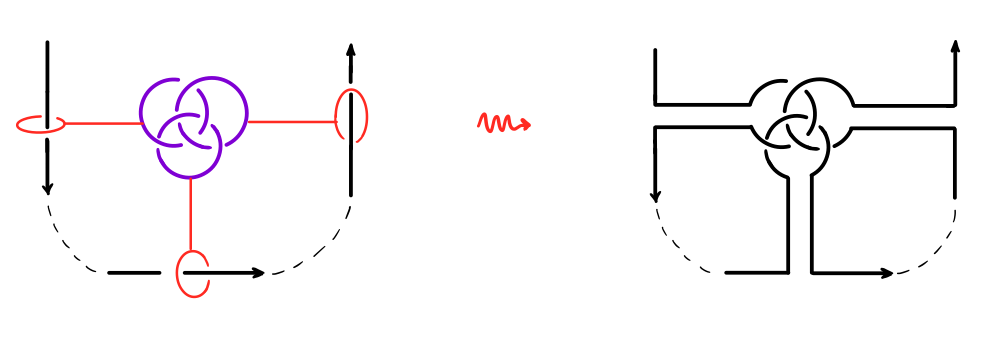
Connect-sum with Borromean rings

For example, two knots are 1-equivalent if they can be related by a sequence of crossing changes. This means that the first term in the filtration is equal to the whole monoid of knots! To get an idea about 2-equivalence, take a look at the operation on the left - grab some three strands of a knot and connect-sum them with the Borromean rings.

Embedding calculus of Goodwillie and Weiss is another homotopy-theoretic approach to spaces of embeddings. When applied to the embedding functor of long knots $\mathcal{K}$ in the 3-space it yields a tower of spaces $T_n$ together with evaluation maps $ev_n\colon K\to T_n$. These spaces turn out to be very interesting. For example, they can be shown to be double loop spaces of the mapping spaces between some (truncated) operads. Hence, their components form an abelian group and the evaluation map from knots gives a map on $\pi_0$ which turns out to be a finite type invariant! It is conjectured to be universal such, in other words, the group of knots modulo relation of n-equivalence is isomorphic to $\pi_0T_n$.

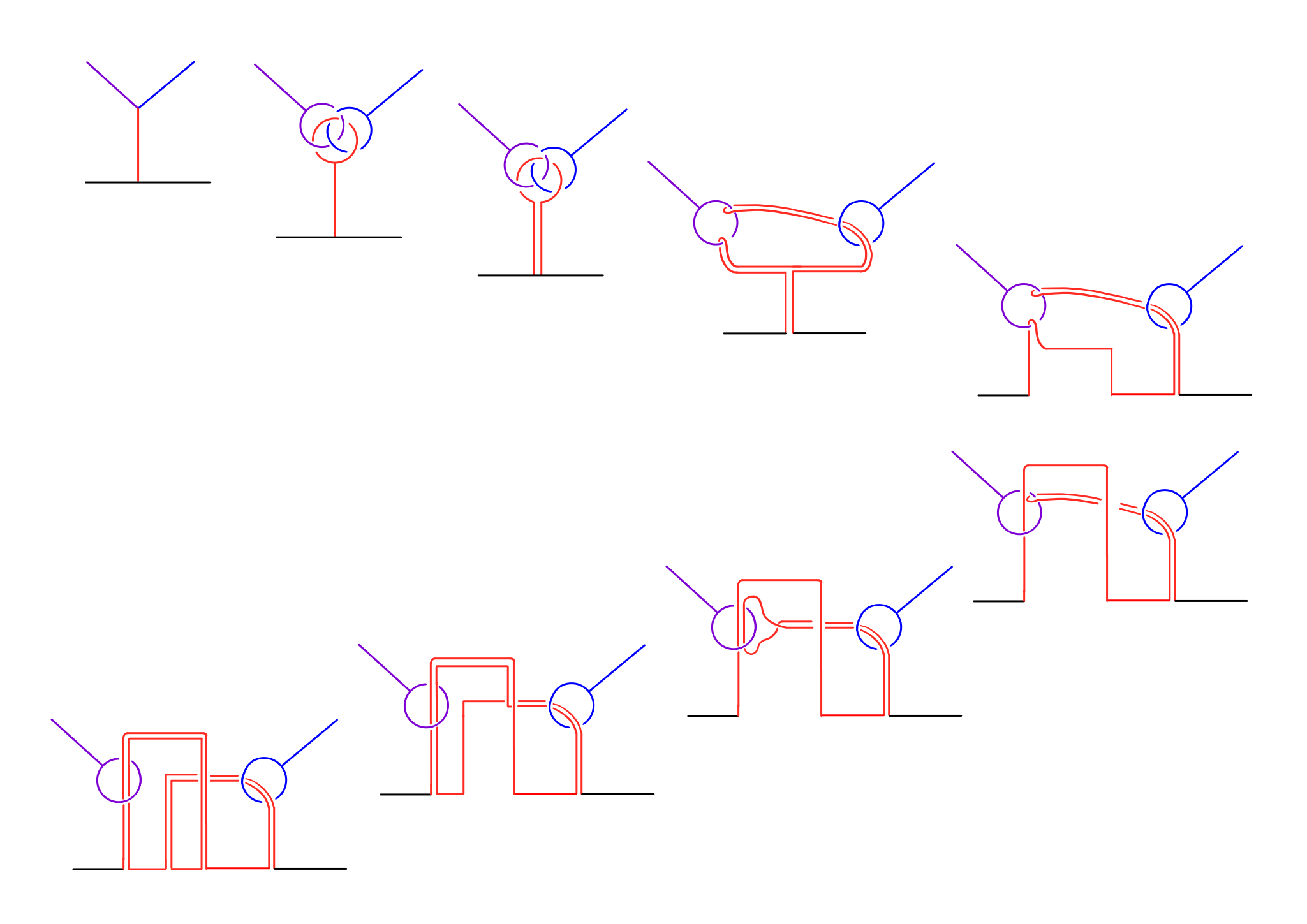
Therefore, the two stories should not be so separate after all. One unifying perspective is that of gropes. Namely, the trivalent vertices appearing in the diagrams for finite type theory (originating in quantum Chern-Simons theory) correspond to the Borromean rings, and the isotopy depicted below hints at how this in turn relates to gropes. In the very last picture we clearly see a genus one surface with one boundary component emerging. This will represent the bottom stage of a grope.

Borromean rings isotopy

Preprints and publications


Invited talks


Expository talks


Archive